Flat irons
Ceramic vs Titanium Flat Irons: Which Is Right for Your Hair?
Ceramic is gentler and even. Titanium is hotter and faster. Here is which one fits your hair, and six irons to start with.
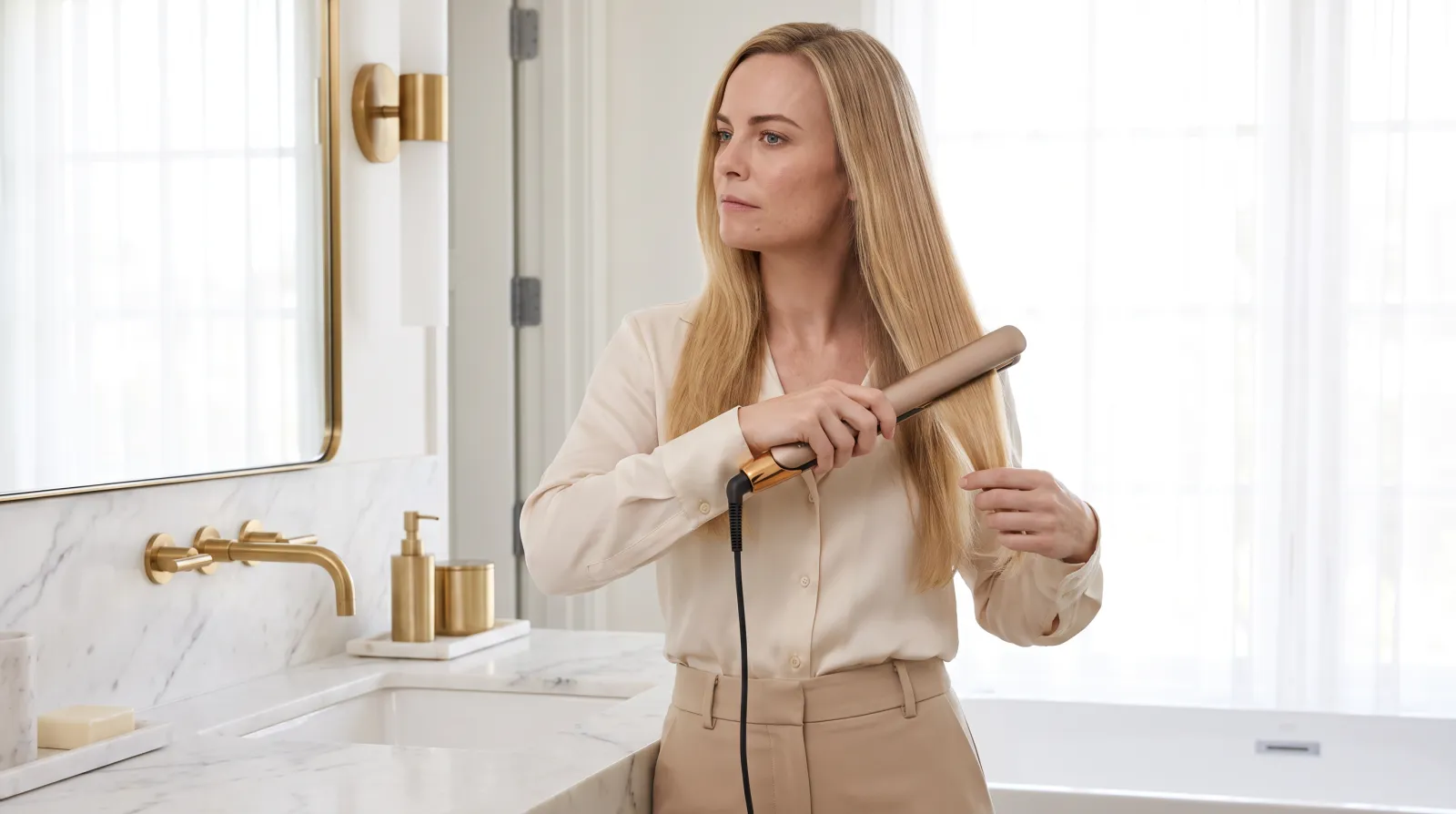
Choose ceramic if your hair is fine, color-treated or easily damaged, and choose titanium if your hair is thick, coarse or hard to straighten. Ceramic plates heat evenly and gently. Titanium plates heat fast and can run hotter. Either can damage hair if you crank the heat, so the setting matters more than the label.
How we chose: we compared manufacturer specs, prices and patterns in owner reviews. We earn a commission if you buy through our links.
Ceramic vs titanium at a glance
| Ceramic | Titanium | |
|---|---|---|
| How it heats | Even, steady | Fast, can run hotter |
| Best for | Fine, color-treated, damaged hair | Thick, coarse, stubborn hair |
| Typical heat range | Lower to medium | Medium to high |
| Risk | Coating can wear off | Easy to overheat |
| Price | Wide range, often lower | Often mid to high |
How each plate heats
Ceramic plates
Ceramic is a material that heats evenly across the surface and releases heat steadily. That means fewer hot spots, which helps if you are working a section more than once. Many ceramic irons are actually a metal plate with a ceramic coating, and some are ceramic all the way through. Coated plates can wear over time, so a chipped or sticky plate means it is time to replace the iron.
Titanium plates
Titanium is a light, strong metal that transfers heat quickly. A titanium iron warms up fast and stays hot even as you pull thick hair through. That speed is useful for coarse hair and quick sessions. It also means the plate can quickly overshoot a temperature your hair is comfortable with, so a titanium iron without a good temperature control is a risk for fine hair.
Many "titanium" irons are a titanium coating on another metal. Some brands, like Hot Tools, describe a coating that mixes titanium with a ceramic finish, so the line between the two types is blurry. Read the product listing rather than relying on the name alone.
Which hair type suits which plate
- Fine or thin hair: ceramic, with low heat. Fine hair burns easily.
- Color-treated or bleached hair: ceramic with a heat control. Treated hair is more fragile, and heat adds stress. Talk to your colorist about a safe limit.
- Thick or coarse hair: titanium, starting medium and moving up only if needed.
- Curly and textured hair: either, as long as there is a precise temperature control. Heat can loosen curl patterns, so go low and use a protectant.
- Short hair and bangs: a slim 1 inch plate, in either material.
- Long hair: 1.25 to 1.5 inch plates cut down the number of passes.
Heat settings: what to use
Stylists often start people in these ranges. They are rules of thumb, not guarantees.
| Hair | Starting range |
|---|---|
| Fine, damaged, bleached | About 300 to 350 degrees F |
| Medium, healthy | About 350 to 400 degrees F |
| Thick, coarse, resistant | About 400 to 450 degrees F, only if needed |
Start low. If the hair does not straighten in one or two slow passes, go up a small step. Passing over the same section many times does more damage than one pass at a slightly higher setting.
What about tourmaline?
You will see "tourmaline ceramic" on many irons. Tourmaline is a mineral. Makers say it adds negative ions that reduce static and frizz. It is a marketing claim more than a proven benefit. It does no harm, and some owners like the finish, but it should not decide your purchase. A good heat control matters more.
Straightening versus curling and waving
Most people use a flat iron for more than straight hair. To curl, clamp the section near the root, rotate the iron half a turn, and slide down slowly. To make waves, twist the section loosely before you pass over it. Both techniques work with either plate type, but they reward precise heat. A tool that overshoots its temperature burns the ends first, because they are the thinnest and oldest part of the hair.
If you do this often, favor a slim iron with rounded edges and a digital or stepped temperature control. Rounded edges stop the sharp creases that flat-edged plates leave behind.
Signs your hair needs a break
Hair that feels rough, snaps when you stretch it gently, looks dull, or has more split ends than usual is telling you that heat styling is too much right now. Cut the heat setting down, skip a few days between uses, and add a conditioning treatment. If the change is sudden or you notice patchy shedding, a dermatologist can check for causes that have nothing to do with styling.
Damage and heat protectant
No flat iron is "safe" in the sense of damage-free. Heat styling can dry hair out, and repeated high heat can cause breakage. Here is how to lower the risk:
- Start with clean, fully dry hair.
- Apply a heat protectant spray or cream, and let it dry.
- Section the hair into manageable pieces, about an inch wide.
- Use the lowest setting that works and glide slowly, once or twice.
- Do not clamp and stop. Keep the iron moving.
- Take breaks. Give your hair days without heat.
If your hair is breaking a lot or your scalp is irritated, check in with a dermatologist or stylist. Also see our hot air brush guide if you want to add smoothness with less direct plate heat.
Three ceramic picks
Best classic ceramic
CHI Original Ceramic Hairstyling Iron
A long-running ceramic-plate iron with floating plates. Older spec sheets list a 1 inch model with a single heat setting around 392 degrees F, and CHI also sells digital versions with preset temperatures, so check the exact model before buying.
- Simple, familiar design
- Floating plates and swivel cord
- Versions differ in controls and plate size
- Basic models give you little temperature control
Best premium ceramic with temperature control
T3 SinglePass X Flat Iron
Listings describe 1.5 inch tourmaline and ceramic plates with five heat settings from 120 to 210 degrees C, a microchip that adjusts temperature, universal voltage and a one-hour auto shut-off. Some retailers show it sold out, so check stock.
- Five heat settings suit fine to medium hair
- Universal voltage for travel
- Premium price
- Sometimes sold out
Best budget ceramic
Conair InfinitiPRO Tourmaline Ceramic 1 inch Flat Iron
Retail listings give a 1 inch tourmaline ceramic plate with a 455 degrees F maximum. The number of heat settings varies between listings, so confirm on the product page.
- Low price
- Tourmaline and ceramic plates
- Listings disagree on heat settings
- Maximum temperature is higher than most fine hair needs
CHI Original: best classic ceramic
The CHI Original is the iron many people recognize. It has ceramic floating plates and a swivel cord. Older spec sheets list a 1 inch version with a single heat setting around 392 degrees F, while newer digital models add preset temperatures. The range of versions is the catch, so pick the one with temperature control if your hair is fine.
T3 SinglePass X: best premium ceramic
Listings describe 1.5 inch tourmaline and ceramic plates, five heat settings from 120 to 210 degrees C (about 250 to 410 degrees F), and a microchip that monitors and adjusts the temperature. It has universal voltage and a one-hour auto shut-off. It is the most precise of the three ceramic picks, and the top range stays within what most hair needs. Stock can be patchy, so check availability.
Conair InfinitiPRO Tourmaline Ceramic: best budget ceramic
Retail listings give a 1 inch tourmaline ceramic plate with a top temperature of 455 degrees F. Listings disagree about how many heat settings it has, so read the exact product page. It is a budget tool, and a safe starting point if you are not sure you will use an iron often.
Three titanium picks
Best titanium for coarse or thick hair
BaBylissPRO Nano Titanium Dual Ionic 1 1/4 inch Flat Iron
BaBylissPRO lists floating 1 1/4 inch titanium plates, ion on and off control, five digital temperature settings up to 450 degrees F, a 9 foot swivel cord and a 4 year limited warranty on this model (BNT9125TC).
- Heat up to 450 degrees F for thick, coarse hair
- Five digital settings
- Too hot for fine or damaged hair at the top setting
- Wide plates are awkward for short hair
Best titanium-coated pick for fast styling
Hot Tools Pro Artist Black Gold 1 inch Flat Iron
Hot Tools describes the Black Gold surface as combining titanium's durability with a ceramic finish to reduce friction, so it is a titanium-based coating rather than a solid plate. Listings give a 455 degrees F maximum with many heat settings.
- Many heat settings
- Titanium and ceramic coating
- Surface is a coating, not solid titanium
- Listings vary by model
Best slim titanium for short hair
BaBylissPRO Nano Titanium 1 inch Ultra-Thin Flat Iron
BaBylissPRO sells a 1 inch ultra-thin Nano Titanium iron (BNT4172T). The slim body makes it easier to reach close to the root and to curl with.
- Slim for short hair and bangs
- Titanium plates heat quickly
- Narrow plates need more passes on long hair
- Check the exact model before buying
BaBylissPRO Nano Titanium Dual Ionic 1 1/4 inch: best for thick hair
BaBylissPRO lists floating titanium plates, ion on and off control, five digital temperature settings up to 450 degrees F, a 9 foot swivel cord and a 4 year limited warranty. The ability to turn the ion function off is unusual. The top temperature is high, so only use it for thick, coarse hair.
Hot Tools Pro Artist Black Gold 1 inch: best budget titanium-style
Hot Tools says its Black Gold surface combines titanium's durability with a ceramic finish to reduce friction, so it is really a titanium-based coating. Listings show a maximum of 455 degrees F and many heat settings. That makes it a good bridge if you are between ceramic and titanium. Models vary, so check the listing.
BaBylissPRO Nano Titanium 1 inch Ultra-Thin: best for short hair
This slim 1 inch iron (BNT4172T) is easier to maneuver near the roots and around bangs, and it can curl hair too. Narrow plates mean more passes on long hair, so it suits short to medium lengths best.
Other things worth checking
Plate width
A 1 inch plate is the all-rounder: it handles straightening and light curls, and it fits short hair. A 1.25 to 1.5 inch plate covers long, thick hair faster. Anything wider than that suits very long, very thick hair but is awkward near the roots.
Floating plates
Floating plates sit on springs, so they adjust to the thickness of the section and apply even pressure. Several irons in this guide use them. They help reduce snagging.
Auto shut-off and cord
An auto shut-off is a safety feature, and a long swivel cord is worth more than it sounds. You will be moving your arms a lot.
Warranty
Irons wear out, and coatings fade. A multi-year warranty, like the four-year warranty BaBylissPRO lists for its Dual Ionic model, is a point in a brand's favor.
Common questions people have
Can ceramic plates chip?
Coated plates can wear, flake or develop sticky spots over time, especially if you use heavy product. If a plate looks damaged, stop using it, because damaged plates can snag and heat unevenly.
Is titanium always hotter?
No. Titanium heats quickly and can reach high temperatures, but the actual temperature depends on the settings you pick. A titanium iron with good controls can run as low as a ceramic one.
Can I use one iron for curling too?
Yes, with practice. A slim 1 inch iron with rounded edges is the easiest to curl with. Wide, flat-edged plates make creases.
Which one should you buy?
Fine, color-treated or damaged hair: T3 SinglePass X, or a budget ceramic like the Conair. Classic and simple: CHI Original with digital control. Thick, coarse or stubborn hair: BaBylissPRO Nano Titanium Dual Ionic. Short hair or bangs: the 1 inch Ultra-Thin. On a tight budget: Hot Tools Black Gold or the Conair.
Whatever you buy, a tool with real temperature control beats a better-sounding plate material. Heat protectant and low settings do more for your hair than the choice between ceramic and titanium. If you also care about quiet drying, see our quietest hair dryers.
Questions people ask
Is ceramic or titanium better for damaged hair?
Ceramic is usually the safer choice because it heats more evenly and tends to run at lower temperatures. Whichever you choose, use the lowest setting that works and a heat protectant.
Is titanium better for thick or curly hair?
Titanium heats fast and holds high heat, which helps with thick, coarse or stubborn hair. Start below the maximum and work up only if needed.
What temperature should I use?
Many stylists suggest roughly 300 to 350 degrees F for fine or damaged hair, 350 to 400 for medium hair, and higher only for thick or coarse hair. Treat these as starting points, not rules.
What does tourmaline do in a flat iron?
Tourmaline is a mineral that makers use in plate coatings. They say it produces negative ions to reduce static and frizz. It is a marketing claim more than a proven difference.
Do I still need a heat protectant?
Yes. Neither plate type removes the damage risk from heat. A protectant spray before styling is a basic step.